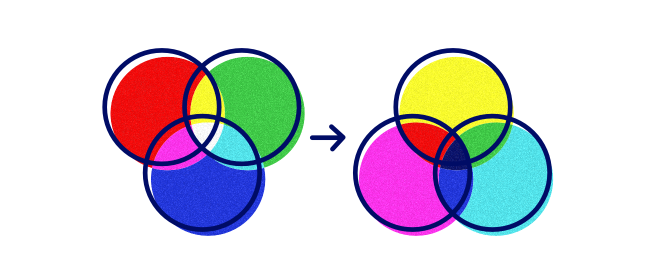
Color Converter
Convert Colors Across Formats
We created a color conversion tool to make it easy to find the hex, RGB, and CMYK values of any color. Select a color using the color wheel or enter a hex code to see RGB, CMYK, and HSL values. For Pantone color matching, use Pantone’s official color finder, which is linked below. But remember, colors look different on every device so if true color matching is important, get yourself a set of PMS swatch books.
or use the color picker below to select a color
Color
#3C4CC4
RGB
CMYK
HSL
Pantone
Pantone is the industry standard for color matching and they created their own tool for finding the closest match within their color system. We would convert them for you here, but it requires a paid license and we are still in start-up-mode here at Studioworks :) Become a member and help us get there!
Understanding Color Systems
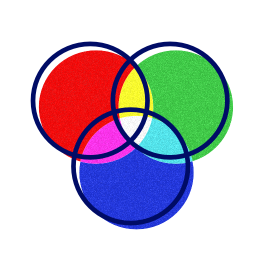
RGB (Red, Green, Blue)
RGB is an additive color model used for digital displays like computer monitors, TVs, and phone screens. Colors are created by combining red, green, and blue light at different intensities, with values ranging from 0 to 255. When all three values are at maximum (255, 255, 255), you get white. When all are at zero (0, 0, 0), you get black. RGB is the standard for web design, digital photography, and anything that will be viewed on a screen. It’s important to remember that the same RGB or HEX color will look different on every screen based on the screen’s color profile or the user’s brightness and temperature settings.
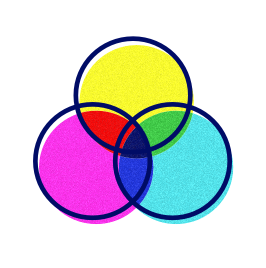
CMYK (Cyan, Magenta, Yellow, Key/Black)
CMYK is a subtractive color model used in color printing. Unlike RGB, CMYK works by subtracting light that would otherwise be reflected. Colors are created by overlaying percentages of cyan, magenta, yellow, and black (key) inks. This is the standard color system for offset printing, digital printing, and any physical materials that will be printed. Colors can look different between RGB (screen) and CMYK (print), so always get a physical proof when color accuracy matters. It’s also important to note that very bright or fluorescent colors are difficult to achieve through CMYK printing and color profiles and often require a special spot color ink.
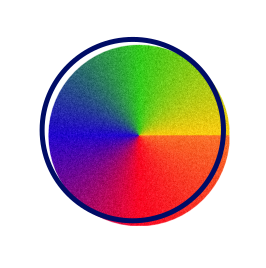
HSL (Hue, Saturation, Lightness)
HSL is a color model that describes colors in terms that are intended to be more intuitive. Hue is the color itself (0–360 degrees on the color wheel), Saturation is the intensity or purity of the color (0% is grayscale, 100% is fully saturated), and Lightness is how bright or dark the color is (0% is black, 100% is white, 50% is pure color). HSL is useful for web design when you need to create variations of a color—just adjust the lightness or saturation values.
Pantone Matching System (PMS)
Pantone is a proprietary color standardization system used in printing and manufacturing. Each Pantone color has a specific number (like “PMS 286 C” or “186 U”) and is created using a precise formula of inks. Pantone colors ensure consistent color reproduction across different printers and materials, which is essential for brand identity and packaging. The “C” suffix indicates Coated paper, while “U” indicates Uncoated paper—the same Pantone color will look different on these surfaces. For true color accuracy, always reference physical Pantone swatch books, as colors can vary between digital displays and printed materials.